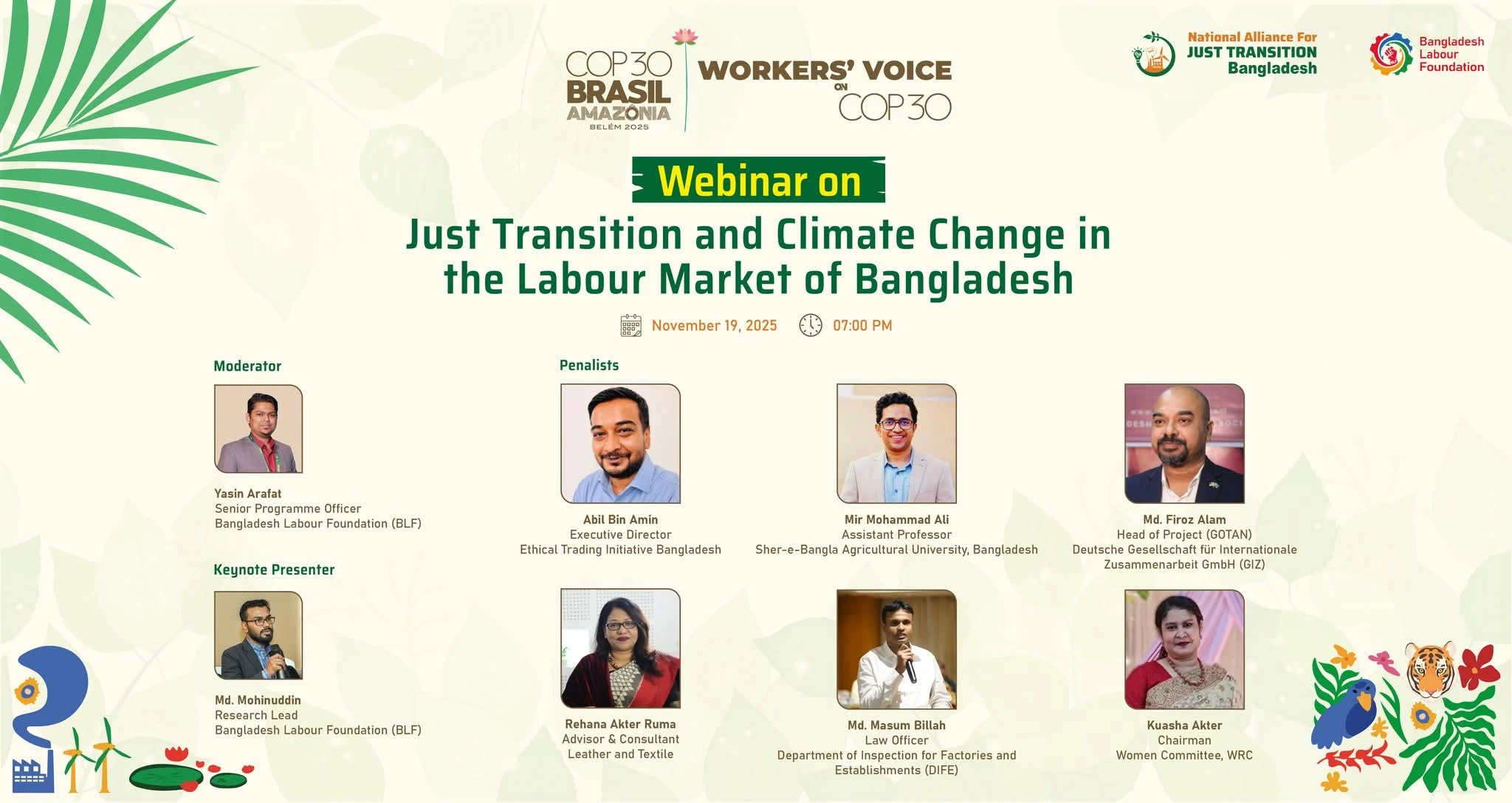
The Bangladesh Labour Foundation (BLF) recently organized a webinar titled “Just Transition and Climate Change in the Labour Market of Bangladesh” to address the growing climate crisis threatening workers.
Moderated by Yasin Arafat (Senior Programme Officer, BLF), the event featured keynote presentation from Md. Mohinuddin (Research Lead, BLF) and insights from panelists: Mir Mohammad Ali (Assistant Professor, Sher-e-Bangla Agricultural University), Abil Bin Amin (Executive Director, Ethical Trading Initiative Bangladesh), Rehana Akter Ruma (Advisor & Consultant, Leather and Textile), Md. Masum Billah (Law Officer, DIFE, MOLE), and Kuasha Akter (Chairman, Women Committee, WRC).
Workers at the Frontline of Climate Impacts
Over 60% of worker households face severe financial stress due to climate disruptions, while 82% experience extreme heat stress that causes chronic headaches and reduced productivity. Women workers face several challenges, with 1 in 4 reporting menstrual irregularities linked to heat and chemical exposure. The financial burden is substantial, as 52% of workers spend BDT 200–999 monthly on illness-related expenses. Perhaps most concerning, nearly 24% feel job insecurity from climate risks, with the figure rising to 35% in the leather sector. Nearly 40% of workers lack any social protection, and only 10.5% have health insurance. Climate-driven displacement is already occurring, with 10.3% of workers having migrated due to lack of employment opportunities.
What Workers Demand
Workers have been clear about their priorities for survival and transition. The overwhelming majority; 88.2%, seek reskilling and training to prepare for changing labour demands. Around 74% demand higher wages and improved workplace cooling, while 71.3% need access to alternative livelihoods. These demands reflect workers’ determination to adapt if given the right support.
Expert Solutions for Just Transition
The panelists outlined comprehensive recommendations across multiple sectors. On worker protection, Md. Masum Billah emphasized that “Bangladesh must establish official workplace temperature standards,” while Mir Mohammad Ali and Rehana Akter Ruma stressed the need to deploy cooling technologies in heat-stress factories using the Loss and Damage Fund. Strengthening occupational safety standards with mandatory personal protective equipment and modernized labour inspection systems is essential. Kuasha Akter highlighted that “gender-sensitive protections, including daycare facilities and job security guarantees, are critical for women workers.”
On policy and coordination, policymakers must develop national frameworks and sector-specific action plans integrating high-risk sectors into broader labour market policies. Masum Billah noted that weak inter-ministerial coordination remains a significant barrier requiring stronger accountability mechanisms and joint action plans.
Rehana Akter Ruma pointed out that “many factory owners remain unaware of existing green financing opportunities,” highlighting the need for awareness campaigns.
Reskilling programs must prioritize women workers to address technological and digital adaptation gaps. Mir Mohammad Ali stressed that “any use of green funds and technology transfer must ensure decent work standards; otherwise, the transition will not be just.” Systems must also track displaced workers for targeted support.
International engagement is equally important. Abil Bin Amin emphasized that “international brands must focus on shared responsibility and transparency, aligning environmental and social pillars as non-negotiable commitments.” Trade unions need empowerment to raise worker demands at global forums. As Bangladesh prepares for LDC graduation, Rehana Akter Ruma noted that environmental and social compliance is now a global market reality.
The Path Forward
The webinar made clear that climate justice and workers’ rights are inseparable. Bangladesh’s export sectors can achieve sustainability only by protecting and empowering the. The evidence is compelling, the solutions are actionable, and the window for just action is narrowing. Bangladesh must act now.