
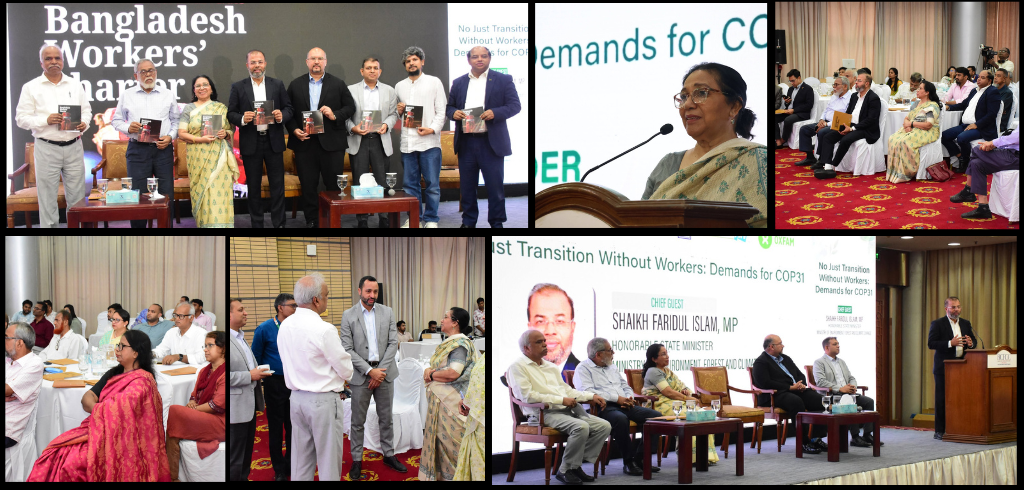
The “𝗕𝗮𝗻𝗴𝗹𝗮𝗱𝗲𝘀𝗵 𝗪𝗼𝗿𝗸𝗲𝗿𝘀’ 𝗖𝗵𝗮𝗿𝘁𝗲𝗿 𝗳𝗼𝗿 𝗖𝗢𝗣𝟯𝟭: 𝗖𝗮𝗹𝗹𝘀 𝗳𝗼𝗿 𝗪𝗼𝗿𝗸𝗲𝗿 𝗥𝗲𝗽𝗿𝗲𝘀𝗲𝗻𝘁𝗮𝘁𝗶𝗼𝗻, 𝗥𝗶𝗴𝗵𝘁𝘀 𝗮𝗻𝗱 𝗙𝗮𝗶𝗿 𝗖𝗼𝗺𝗽𝗲𝗻𝘀𝗮𝘁𝗶𝗼𝗻” was presented on 14 October 2026 by the National Alliance for Just Transition – Bangladesh (NAJTBD), in collaboration with Bangladesh Labour Foundation (BLF) and Manusher Jonno Foundation (MJF), at a national multi-stakeholder dialogue in Dhaka. The Charter calls for workers’ priorities to be reflected in climate policies and international negotiations ahead of COP31.
The dialogue was attended by representatives of government, workers’ organisations, civil society, and other stakeholders. Addressing the event as the chief guest, Shaikh Faridul Islam, MP, State Minister for Environment, Forest and Climate Change, described the Charter as timely and comprehensive and assured that the Ministry would make efforts to incorporate relevant demands into national and local climate policies and Bangladesh’s COP31 position.
Advancing a Worker-Centred Just Transition
The dialogue focused on the Bangladesh Workers’ Charter for COP31, which outlines 23 demands across eight negotiation tracks. It highlights the urgent need to protect workers’ livelihoods, strengthen labour rights, ensure fair compensation for climate-related loss and damage, and secure meaningful worker participation in climate decision-making.
With approximately 84% of Bangladesh’s workforce engaged in informal employment, workers—particularly women and those living in climate-vulnerable communities—face increasing risks from extreme heat, climate-induced displacement, industrial decarbonisation, and technological change. The Charter calls for a rights-based Just Transition that protects workers while preparing them for a greener and more sustainable economy.
Key Discussions
Ensuring meaningful representation of workers, including women workers, in Bangladesh’s official COP31 delegation
Protecting workers’ livelihoods, income, and employment through a rights-based Just Transition
Securing adequate, grant-based climate finance and fair compensation for climate-related loss and damage
Strengthening occupational safety, social protection, and support for workers affected by extreme heat and other climate impacts
Investing in skills development and funded reskilling programmes to prepare workers for green jobs and technological transformation
Integrating workers’ priorities into national and local climate policies and Bangladesh’s COP31 negotiating position
The Charter was developed through eight consultations, with contributions from 43 organisations, reflecting a collective effort to ensure that workers’ voices are represented in climate policy and international negotiations.
Through its collaboration with the National Alliance for Just Transition – Bangladesh and Manusher Jonno Foundation, BLF continues to advocate for a worker-centred approach to climate action. As Bangladesh prepares for COP31, BLF calls for a Just Transition that leaves no worker behind—one that recognises workers not merely as victims of climate change, but as essential stakeholders in shaping climate solutions, protecting livelihoods, and building a fairer, greener economy.