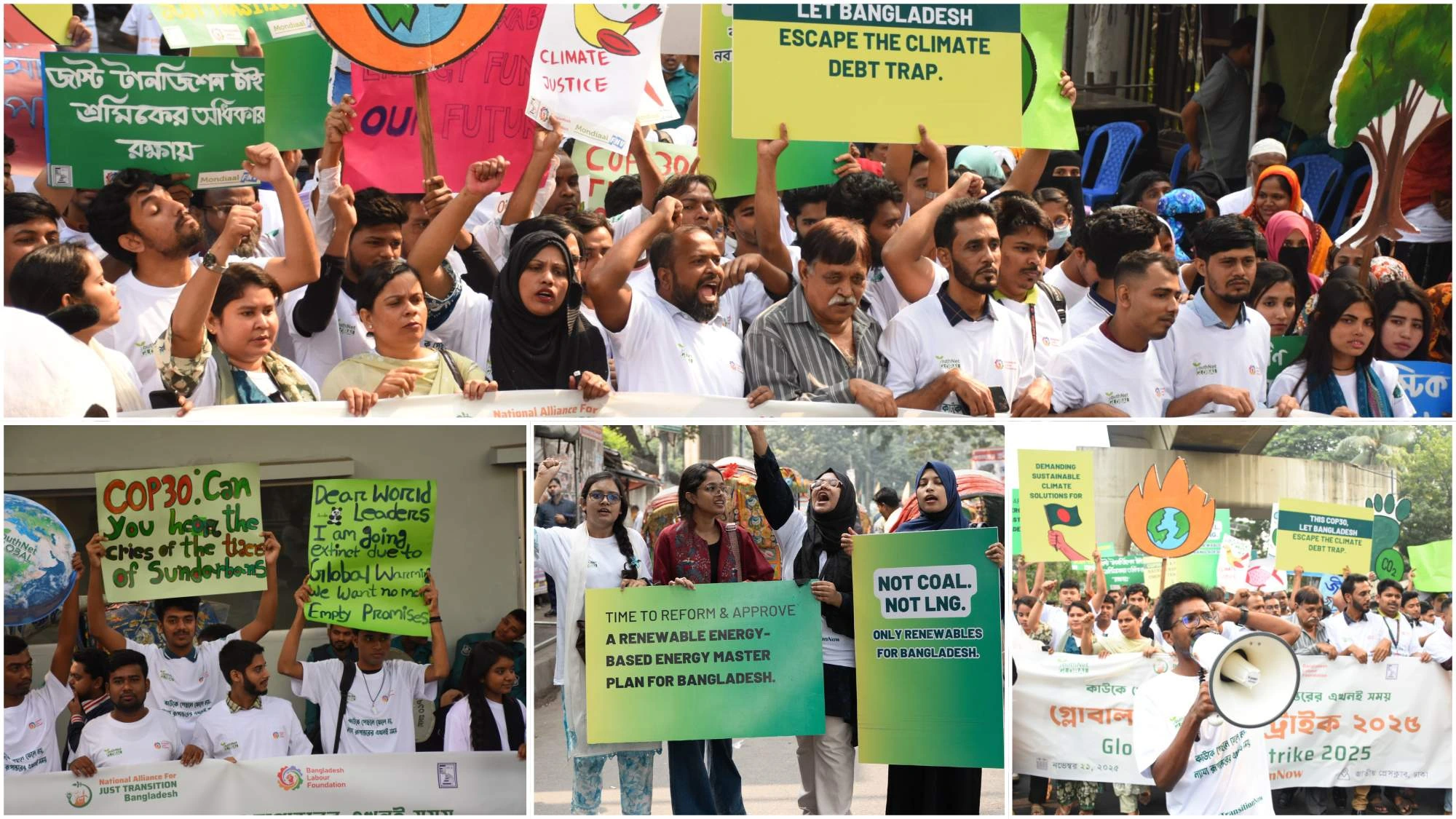
As world leaders meet at COP30 in Brazil, hundreds of young people, workers, and climate-affected communities marched in Dhaka demanding climate justice and a Just Transition that prioritizes people over profit.
Organized by YouthNet Global, Bangladesh Labour Foundation (BLF), National Alliance for Just Transition Bangladesh (NAJTB), and Bangladesh Institute of Labor Studies (BILS), the strike demanded three critical actions: a renewable energy-based revision of Bangladesh’s fossil-fuel-heavy energy master plan, protection of workers’ rights throughout the energy transition, and operationalization of Loss & Damage finance and grant-based climate finance.
Core Demands
Protesters rejected false climate solutions and called for an energy transition rooted in justice. They demanded that solar and wind energy investments prioritize transparency, community inclusion, and equity while safeguarding livelihoods and expanding social protection. Climate justice, activists stressed, must incorporate economic, gender, and worker justice with meaningful participation of youth, workers, and frontline communities in all climate decisions.
Message to COP30
Youth and labour rights activists urged COP30 decision-makers to deliver a renewable, inclusive, and grant-supported global climate agenda that strengthens adaptation, operationalizes Loss & Damage funding, and advances a Just Transition grounded in human rights and worker dignity.
For Bangladesh’s millions of workers already facing climate impacts in sectors like RMG, leather, and footwear, the stakes are existential. Without a just transition framework, vulnerable communities will bear the burden of both climate change and poorly managed energy transitions.