
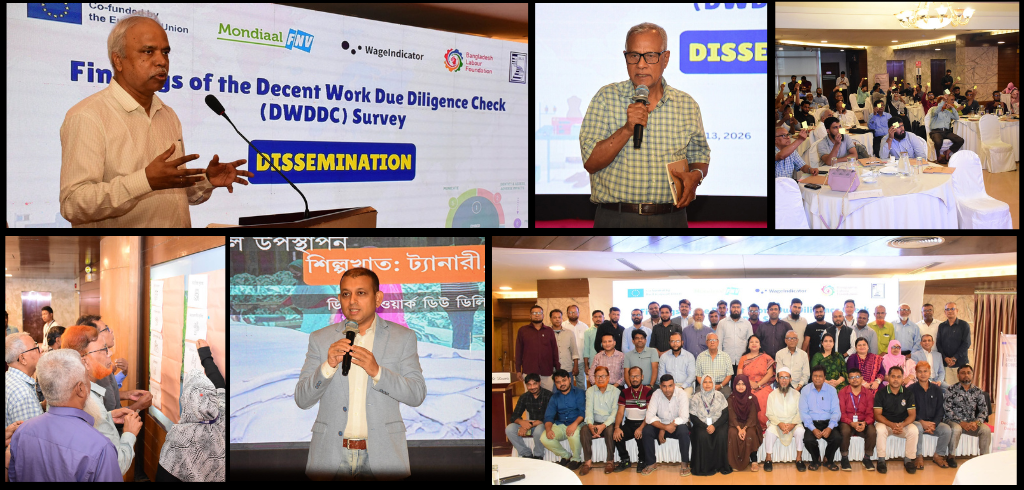
The “𝗗𝗲𝗰𝗲𝗻𝘁 𝗪𝗼𝗿𝗸 𝗶𝗻 𝗔𝗰𝘁𝗶𝗼𝗻, 𝗛𝘂𝗺𝗮𝗻 𝗥𝗶𝗴𝗵𝘁𝘀 𝗳𝗼𝗿 𝗔𝗹𝗹” programme, titled “Dissemination of the Findings of the Decent Work Due Diligence Check (DWDDC) Survey in the Tannery, Leather Goods and Footwear Sectors,” was jointly organized by Bangladesh Labour Foundation (BLF) and the Bangladesh Institute of Labour Studies (BILS) on 13 July 2026. The event was organized under the Decent Work Due Diligence Bangladesh (DWDDB) Project, implemented by BLF in partnership with Mondiaal FNV, WageIndicator Foundation, and BILS, with support from the European Union in Bangladesh.
The programme brought together trade union leaders and representatives from the tannery, leather goods, and footwear sectors to present the survey findings, validate workers’ experiences, identify priority workplace concerns, and explore evidence-based approaches to strengthening labour rights, responsible business practices, and decent working conditions in Bangladesh.
Advancing Decent Work through Worker-Driven Evidence
The event commenced with welcoming remarks by AKM Ashraf Uddin, Executive Director of BLF, who emphasized the importance of workers’ voices and evidence-based dialogue in promoting decent work and responsible business conduct.
The DWDDC Survey findings were presented by Yasin Arafat, Project Coordinator of DWDDB, BLF. The survey captures workers’ experiences, perceptions, and concerns regarding workplace conditions, labour rights, Human Rights Due Diligence (HRDD), Responsible Business Conduct (RBC), forced labour, and modern slavery. By incorporating workers’ lived experiences into the evidence base, the survey helps identify workplace challenges and priorities from the perspectives of those directly affected.
Key Discussions
Presentation and assessment of the DWDDC Survey findings on working conditions, labour rights, and human rights risks in the tannery, leather goods, and footwear sectors
Interactive priority-setting and feedback sessions to validate survey findings and identify practical recommendations for improving workers’ rights and workplace conditions
Demonstration of the online DWDDC Survey Results Dashboard by Shahinur Rahman, Advisor, Mondiaal FNV, highlighting its role in transforming survey data into accessible, evidence-based information
Strengthening trade union advocacy and policy engagement through reliable data on workplace and sector-level challenges
Promoting meaningful social dialogue among workers, employers, government, brands, and other industry stakeholders
Supporting collective bargaining and workplace-level negotiations through evidence-based information
- Encouraging employers, brands, and supply-chain actors to identify workplace risks and strengthen the implementation of HRDD and RBC commitments
Shahinur Rahman demonstrated how the online DWDDC Survey Results Dashboard can help trade unions identify priority concerns, strengthen advocacy, support collective bargaining, engage with relevant stakeholders, and monitor progress towards improved labour rights and decent working conditions.
Syed Sultan Uddin Ahmed, Executive Director of BILS, emphasized the significance of the DWDDC Dashboard as a national-level knowledge product that provides a strong evidence base for advocacy, informed decision-making, policy intervention, and improved workplace practices.
Trade union leaders from the tannery, leather goods, and footwear sectors across Bangladesh participated in the programme, contributing their perspectives and recommendations on the challenges facing workers in these industries.
Bangladesh Labour Foundation (BLF), in collaboration with BILS and its project partners, continues to promote worker-centred approaches to decent work, human rights, and responsible business practices. The DWDDC Survey findings and online Dashboard represent important tools for strengthening trade union advocacy, facilitating meaningful social dialogue, supporting effective human rights due diligence, and advancing workers’ rights and decent work throughout Bangladesh’s tannery, leather goods, and footwear sectors.