
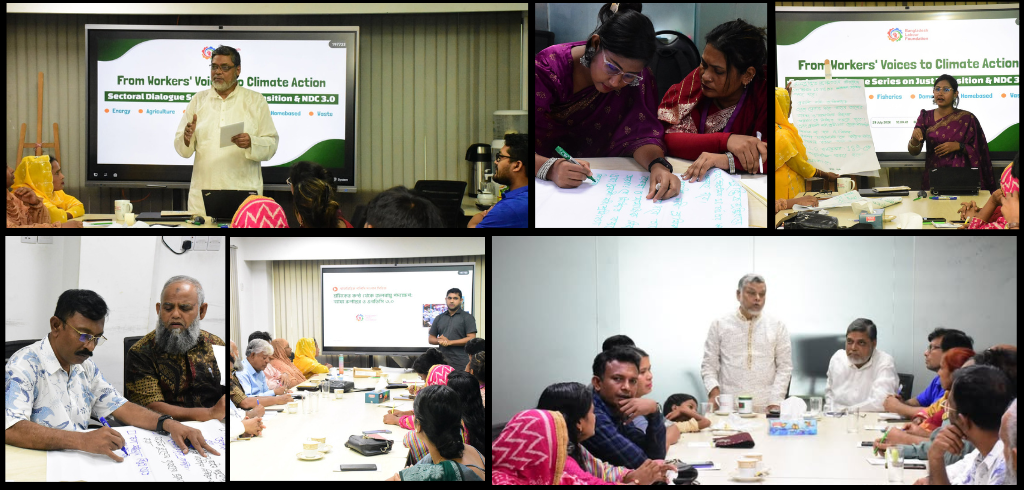
The “𝗘𝗺𝗽𝗼𝘄𝗲𝗿𝗶𝗻𝗴 𝗪𝗼𝗿𝗸𝗲𝗿𝘀’ 𝗩𝗼𝗶𝗰𝗲𝘀 𝗶𝗻 𝗖𝗹𝗶𝗺𝗮𝘁𝗲 𝗔𝗰𝘁𝗶𝗼𝗻: 𝗦𝗲𝗰𝘁𝗼𝗿𝗮𝗹 𝗗𝗶𝗮𝗹𝗼𝗴𝘂𝗲 𝗼𝗻 𝗝𝘂𝘀𝘁 𝗧𝗿𝗮𝗻𝘀𝗶𝘁𝗶𝗼𝗻 & 𝗡𝗗𝗖 𝟯.𝟬” was organized by Bangladesh Labour Foundation (BLF) on 29 July 2026 in Dhaka as the second dialogue in its sector-based policy dialogue series, “Workers’ Voices in Climate Action: Just Transition and NDC 3.0,” reaffirming the importance of placing workers at the centre of Bangladesh’s climate policies and transition planning.
The dialogue brought together trade union leaders and worker representatives from the Agriculture, Energy, Fisheries, Waste Management, Domestic Work, and Home-Based Work sectors to identify sector-specific climate risks, employment challenges, and policy priorities to ensure a fair, inclusive, and worker-centred transition towards a low-carbon and climate-resilient economy.
Advancing a Worker-Centred Just Transition and NDC 3.0
The discussion focused on ensuring that workers’ voices, vulnerabilities, and priorities are reflected in the implementation plan for Bangladesh’s Nationally Determined Contribution (NDC) 3.0. Participants highlighted the need to address the effects of climate change on workers’ livelihoods, employment security, occupational health and safety, and access to social protection while preparing workers for emerging opportunities in a greener economy.
Key Discussions
Assessing the impacts of climate change on workers’ livelihoods, employment, and income security across different sectors
Addressing occupational health and safety concerns and climate-related workplace risks
Strengthening social protection mechanisms to support workers affected by climate change and economic transformation
Promoting skills development, reskilling, and upskilling opportunities to prepare workers for changing technologies and emerging green jobs
Ensuring decent work, fair employment opportunities, and the protection of labour rights throughout the transition to a low-carbon economy
Strengthening the meaningful participation of workers and trade union representatives in climate policymaking, decision-making, and implementation
- Developing sector-specific recommendations to address the distinct challenges and vulnerabilities of workers in agriculture, energy, fisheries, waste management, domestic work, and home-based work
The dialogue provided an important platform for trade union leaders and worker representatives to share their experiences, highlight sector-specific challenges, and propose practical policy recommendations. It emphasized that climate action must go beyond environmental objectives to protect workers’ rights, secure livelihoods, promote decent work, and ensure that vulnerable and informal workers are not left behind.
The recommendations gathered through this dialogue will contribute to the development of the Workers-Centred NDC 3.0 Just Transition Implementation Plan, helping ensure that Bangladesh’s climate commitments reflect the realities and priorities of workers across diverse sectors. Through this initiative, BLF continues to promote inclusive social dialogue and stronger worker participation in shaping a just, equitable, and sustainable future for Bangladesh.