
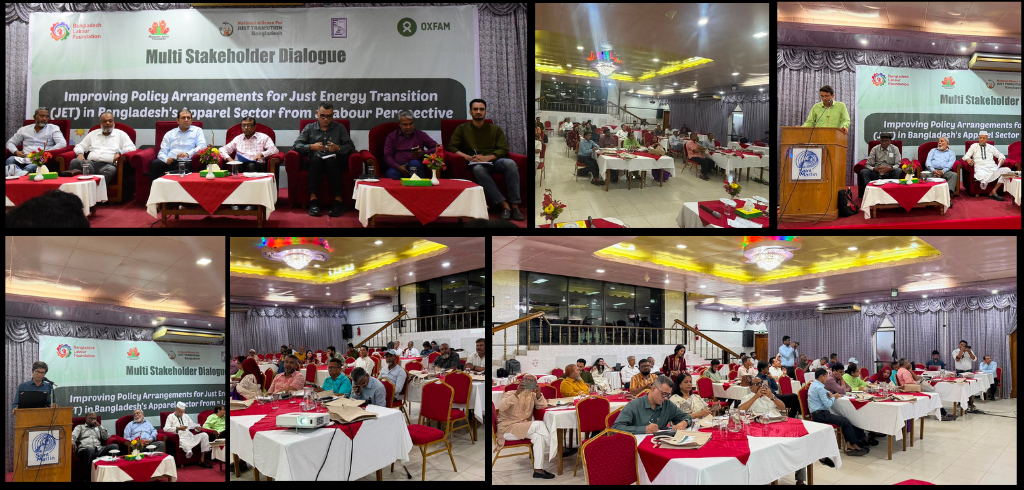
The “𝗦𝘁𝗮𝗸𝗲𝗵𝗼𝗹𝗱𝗲𝗿𝘀 𝗖𝗮𝗹𝗹 𝗳𝗼𝗿 𝗮 𝗪𝗼𝗿𝗸𝗲𝗿-𝗖𝗲𝗻𝘁𝗿𝗲𝗱 𝗚𝗿𝗲𝗲𝗻 𝗧𝗿𝗮𝗻𝘀𝗶𝘁𝗶𝗼𝗻 𝗶𝗻 𝗕𝗮𝗻𝗴𝗹𝗮𝗱𝗲𝘀𝗵’𝘀 𝗔𝗽𝗽𝗮𝗿𝗲𝗹 𝗦𝗲𝗰𝘁𝗼𝗿” multi-stakeholder dialogue titled “Improving Policy Arrangements for Just Energy Transition in Bangladesh’s Apparel Sector from a Labour Perspective” was jointly organized by the National Alliance for Just Transition Bangladesh (NAJTB), Bangladesh Labour Foundation (BLF), Bangladesh Institute of Labour Studies (BILS), and Manusher Jonno Foundation (MJF), with support from Oxfam Bangladesh, in Chattogram.
The programme was chaired by A M Nazim Uddin, Regional Coordinator of NAJTB, and attended by representatives from government, workers’ organizations, civil society, academia, and development partners. Jamir Uddin, Director of the Department of Environment, Chattogram Region, attended as the Chief Guest, while Md Anowar Hossain, Chief Coordinator of NAJTB, joined as the Special Guest.
Advancing a Worker-Centred Just Energy Transition
The dialogue focused on strengthening policy arrangements for a just energy transition in Bangladesh’s apparel sector, emphasizing employment protection, workers’ skills development, social protection, occupational safety, trade union rights, and meaningful worker participation in shaping the transition.
Key Discussions
Recognizing just transition as a socio-technical transformation, not merely a technological shift
Ensuring workers, particularly vulnerable and women workers, do not bear a disproportionate share of the costs of decarbonization
Promoting reskilling and upskilling alongside industrial modernization to protect employment and prevent structural unemployment
Ensuring that green factories also uphold decent work, living wages, occupational safety, responsible business conduct, and trade union rights
Establishing a dedicated Just Transition Fund supported by vulnerability mapping, tripartite social dialogue, and targeted financial assistance
Institutionalizing meaningful participation of workers and trade unions in designing, implementing, and monitoring transition policies
- Applying lessons from the apparel sector to other sectors including shipbreaking, leather, transport, agriculture, fisheries, and waste management
The key presentation was delivered by Dr Masud Kamal, Professor of Sociology at the University of Chittagong, who highlighted the importance of distributive justice to ensure that workers do not bear the costs of decarbonization alone. BLF Executive Director and NAJTB Secretary A K M Ashraf Uddin emphasized that workers must remain at the centre of the transition through adequate social protection, reskilling opportunities, employment security, and worker-focused planning.
Md Zubaer Alam, Programme Officer at BLF, further highlighted the need to translate just transition principles into concrete policies through institutional accountability and stronger coordination among government agencies, employers, trade unions, civil society, and regulators.
The dialogue reinforced the shared understanding that Bangladesh’s transition towards a greener economy can only be truly just when workers are active participants in shaping the policies that determine their future of work. NAJTB and its partners remain committed to advancing a worker-centred Just Transition through social dialogue, evidence-based advocacy, skills development, decent work, and stronger worker participation in climate and energy policy.