
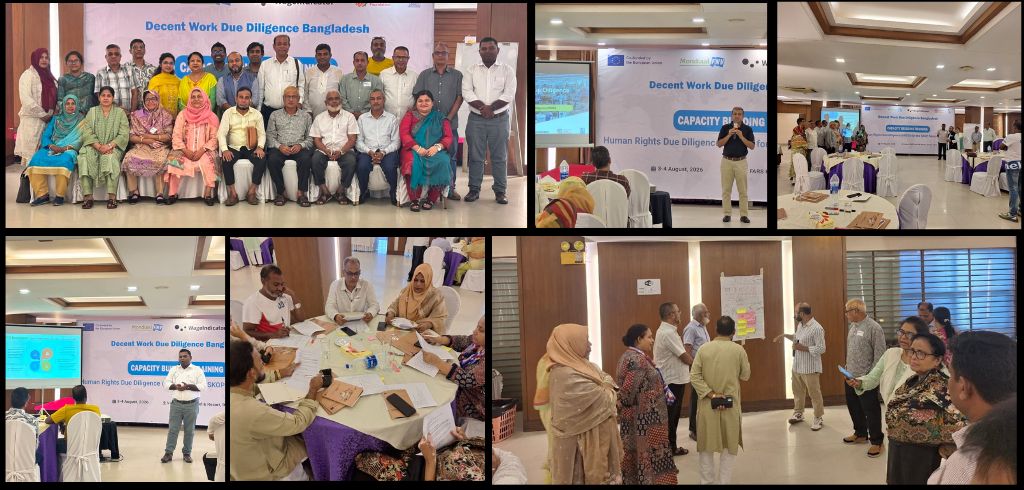
Bangladesh Labour Foundation (BLF), in collaboration with Mondiaal FNV and the Bangladesh Institute of Labour Studies (BILS), co-hosted a two-day capacity-building training on Human Rights Due Diligence (HRDD) for senior and mid-level leaders of Sromik Kormochari Oikya Parishad (SKOP), the platform of national trade union centres in Bangladesh, to strengthen trade unions’ capacity to protect workers’ rights and promote responsible business practices.
The training was organized under the Decent Work Due Diligence Bangladesh (DWDDB) Project, jointly implemented by BLF, Mondiaal FNV, WageIndicator Foundation, and BILS, with co-funding from the European Union in Bangladesh.
𝗘𝗺𝗽𝗼𝘄𝗲𝗿𝗶𝗻𝗴 𝗧𝗿𝗮𝗱𝗲 𝗨𝗻𝗶𝗼𝗻𝘀 𝗳𝗼𝗿 𝗠𝗲𝗮𝗻𝗶𝗻𝗴𝗳𝘂𝗹 𝗛𝘂𝗺𝗮𝗻 𝗥𝗶𝗴𝗵𝘁𝘀 𝗗𝘂𝗲 𝗗𝗶𝗹𝗶𝗴𝗲𝗻𝗰𝗲
The training focused on strengthening trade union leaders’ understanding of HRDD and Responsible Business Conduct, highlighting the importance of ensuring that workers’ voices are heard throughout due diligence processes. Through discussions, group exercises, and practical learning, participants explored how trade unions can identify risks, prevent harm, monitor progress, and support workers’ access to remedy.
Key Discussions
Understanding Human Rights Due Diligence (HRDD) and Responsible Business Conduct
Exploring international labour standards and emerging human rights due diligence legislation
Strengthening the role of trade unions in identifying human rights risks and preventing workplace harm
Monitoring due diligence commitments and promoting accountability in business operations and supply chains
Supporting workers’ access to effective grievance mechanisms and remedy for rights violations
Ensuring that HRDD goes beyond compliance to deliver tangible improvements in workers’ rights, dignity, and working conditions
Through this initiative, BLF and its partners continue to strengthen the capacity of national trade union leaders to engage meaningfully in human rights due diligence processes. By promoting worker participation, trade union advocacy, and responsible business conduct, the DWDDB Project aims to ensure that HRDD leads to real improvements in working conditions and the protection of workers’ rights across supply chains.